
A contribution from Thomas Giegerich
Welcoming students to an introduction to the U.S. legal system and mock trial at a German university today is more challenging than usual. All those who teach and attend such a course obviously believe in the importance of the rule of law on both sides of the Atlantic.
U.S. constitutional law has had a major influence on the development of constitutional law in Germany ever since the unsuccessful attempt to establish a German federal constitution in 1848-9. That constitution would have had its own Bill of Rights as well as a supreme court modelled on the U.S. Supreme Court. The influence which U.S. concepts have had on our current Basic Law is also considerable, for instance regarding the federal structure of Germany.
Concerning criminal procedure, Germans who have watched so many Hollywood movies and TV series often know more about the procedural practice in the U.S. than in Germany. German law students who for the first time observe a criminal trial in their own country are surprised that defendants aren’t asked whether they plead guilty or not guilty. And of course, we are all familiar with the police officers in lots of U.S. TV series reading the constitutionally required Miranda warnings to the suspect: “You have the right to remain silent and refuse to answer questions. Anything you say may be used against you in a court of law …”
The US Constitution of 1787 makes for interesting reading these days. To give you just one example: Art. II, section 3 says that the President “shall take Care that the Laws be faithfully executed”. This of course includes international law, and in particular treaties such as the UN Charter that prohibits the use of military force in international relations in Art. 2 (4). Art. VI, section 2 of the Constitution expressly determines that “Treaties made, or which shall be made, under the Authority of the United States, shall be the supreme Law of the Land”.
2026 is an extraordinary year, because on July 4th, we will celebrate the 250th anniversary of the American Declaration of Independence – on both sides of the Atlantic. It proclaims the self-evident truths that “all men are created equal, that they are endowed by their Creator with certain unalienable rights, that among these are Life, Liberty and the pursuit of Happiness. That to secure these rights, Governments are instituted among Men, deriving their just powers from the consent of the governed.” In February 1776 already, Thomas Paine had written in his pamphlet “Common Sense”: “But where, say some, is the King of America? … in America the law is king. For as in absolute governments the King is law, so in free countries the law ought to be king; and there ought to be no other.”[2]
The Declaration of Independence laid the groundwork for the US Constitution that was adopted eleven years later in the very same room in downtown Philadelphia in a building that is now called Independence Hall. One person deeply involved in the drafting processes of both documents was Benjamin Franklin. Having signed the Constitution, Franklin remarked that he had wondered during the entire duration of the Constitutional Convention whether the backrest of the armchair used by George Washington as President of that Convention depicted a rising or a setting sun. But looking at the outcome he had just signed, he was now convinced that it was a rising sun.[3]
When Franklin left the building shortly thereafter, he was asked by a lady: “Well, Doctor, what have we got – a republic or a monarchy?” Franklin replied: “A republic, if you can keep it.”[4] The question is: Will we be able to keep it in 2026, or will the sun set after all on the enlightened spirit of 1776? I’ve used the term “we” deliberately, because the U.S. Constitution undoubtedly is an American invention based on European political thought, but it has long developed into a major asset of human civilisation. The Americans hold it in sacred trust for all of humankind. Just as the Declaration of Independence proclaimed, the Americans should therefore pay “a decent respect to the opinions of mankind”, also in terms of dealing with their Constitution.
What is at stake now? The strongest formulation one can find was used by Abraham Lincoln during the Civil War in his Gettysburg Address in 1863: “Four score and seven years ago our fathers brought forth on this continent, a new nation, conceived in Liberty, and dedicated to the proposition that all men are created equal. Now we are … testing whether that nation, or any nation so conceived and so dedicated, can long endure.”[5] The situation in 1863 was much more dramatic than today, but rational constitutionalism does not only die in civil wars.
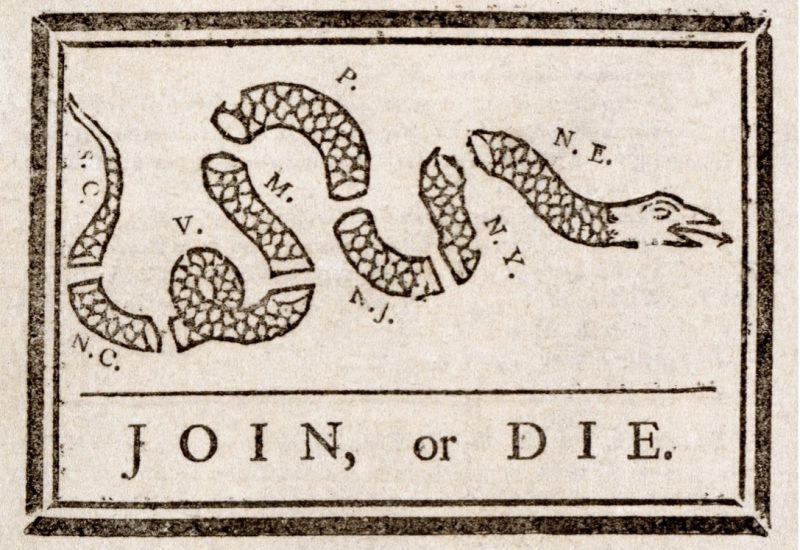
What can we Europeans do? In search for an answer, we should study the cartoon accompanying this blog post.[6]
It was published by Franklin in the Pennsylvania Gazette in 1754 and early on called for unity among the thirteen British colonies in North America in order to ensure their survival. Take it as a reminder of what is at stake for us Europeans in 2026. To use a quotation attributed to Franklin: “We must, indeed, all hang together or, most assuredly, we shall all hang separately”.
European unity and effective decision-making transforming that unity into political action have never been more important. There has even been a suggestion that we Europeans should have a bold “1787 moment”[7] and right now create a new, strong and truly federal European Union, abandoning the imperfect current EU as our American forebears abandoned the dysfunctional Articles of Confederation. This is very much worth considering. One way or the other, we Europeans must take our destiny into our own hands NOW.
[1] This text is the extended version of Thomas Giegerich’s welcome remarks opening an introductory course to US law in Saarbrücken last week.
[2] https://oll.libertyfund.org/pages/1776-paine-common-sense-pamphlet (20 January 2026).
[3] See https://www.nps.gov/articles/000/constitutionalconvention-september17.htm (20 January 2026).
[4] https://blogs.loc.gov/manuscripts/2022/01/a-republic-if-you-can-keep-it-elizabeth-willing-powel-benjamin-franklin-and-the-james-mchenry-journal/ (20 January 2026).
[5] Abraham Lincoln, Selected Speeches and Writings (1992), p. 405.
[6] This image is available from the United States Library of Congress’s Prints and Photograph division under the digital ID cph.3g05315 (19 January 2026).
[7] Samuel Shannon, The EU’s 1787 Moment: When Constitutional Order Blocks Necessary Change, Verfassungsblog, 2 January 2026.
Suggested Citation: Giegerich, Thomas, Europeans must follow legal developments in the United States closely in 2026, jean-monnet-saar 2026.
DOI: 10.17176/20260120-144353-0
Funded by the Deutsche Forschungsgemeinschaft (DFG, German Research Foundation) – Project No.: 525576645
